When Sarah noticed brown patches creeping across her suburban Alabama yard in mid-July, she blamed the heat and upped her watering to every evening with a garden hose. Two weeks later the grass was still stressed and the water bill had jumped by 30%. Across town, Mark had a large, sloped lawn and ran an old irrigation clock three times a week—his runoff puddled in the street. These are real, solvable problems: wrong timing, wrong method, wrong equipment. This article walks through common mistakes homeowners make when trying to follow a lawn watering schedule that actually works, and gives practical fixes matched to specific lawn situations.
1. Mistake: Watering at the Wrong Time of Day — Fix with Timing and Controls
Problem: Watering in the heat of the day or late at night wastes water. Daytime evaporation can cut effective irrigation by 30–50%, and very late watering encourages fungal diseases.
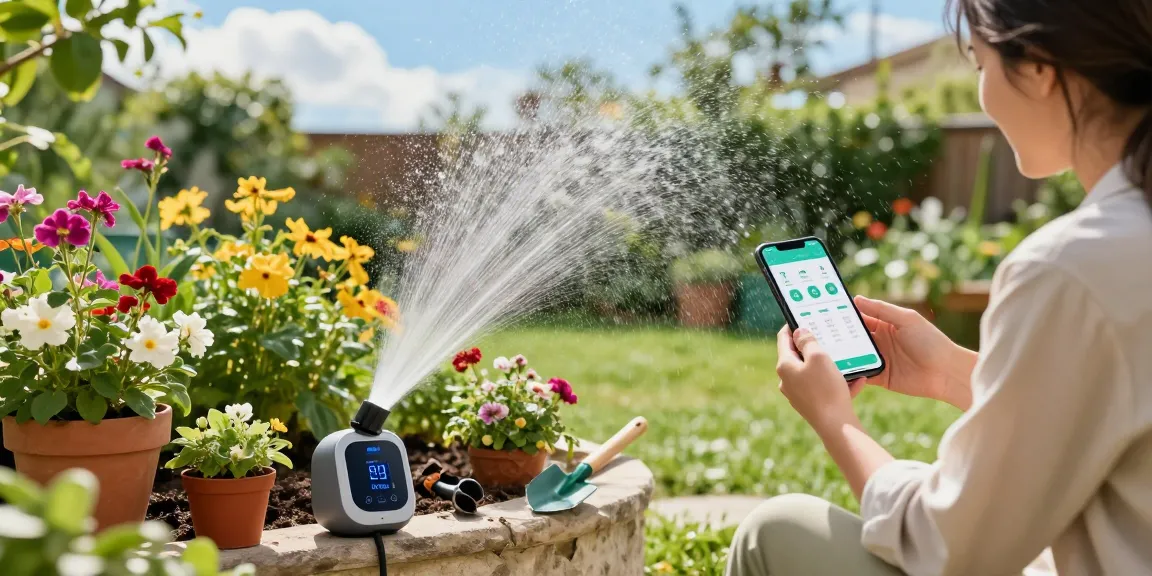
Solution: Water early morning—generally between 4 a.m. and 9 a.m.—when winds are calm and temperatures are low. For small lawns using a portable sprinkler, set a timer on your hose faucet or use a battery timer so watering starts before sunrise. Homeowners with larger yards should consider a WiFi sprinkler timer that can automatically shift schedules based on local weather.
Scenario fit
For Sarah’s medium-sized yard, a WiFi timer such as the RainPoint model lets her schedule two short runs before sunrise and skip cycles when the forecast calls for rain. For Mark’s large lawn on a slope, a smart controller that splits cycles into 5–10 minute “soak” repeats prevents runoff and improves infiltration.
Quick data point: According to the EPA, smart irrigation controllers can save homeowners up to 15% on outdoor water use compared with conventional controllers, and in some settings much more when combined with efficient hardware (EPA WaterSense).
2. Mistake: Too-Frequent, Shallow Watering — Fix with Depth Targets and Soil Checks
Problem: Many people water daily for short periods. That trains shallow roots, meaning your lawn becomes more drought-prone and demands even more water.
Solution: Aim for deep, infrequent watering to encourage roots to grow 4–6 inches deep. Most turf needs about 1 to 1.25 inches of water per week, delivered in 2–3 sessions depending on soil. Use a simple cup test (place straight-sided containers around the lawn) or a soil probe to measure how much water is getting down.
Example schedule
Soil TypeSessions per WeekMinutes per Session (typical lawn sprinkler)Sandy312–18Loam2–318–25Clay225–35 (split cycles to avoid runoff)
Concrete fix: If a quick 10-minute run wets only the top inch, add another run later in the morning to reach deeper. For a precise, automated approach you can follow a lawn watering schedule that actually works that adapts run times to soil and season.
3. Mistake: Using the Wrong Hardware — Fix by Matching Method to Lawn Type
Problem: Sprinklers and hoses are not one-size-fits-all. A soaker hose on a sloped lawn causes runoff; high-pressure rotary sprays on an irregular small lawn cause overspray and wasted water.
Solution: Match the system to the situation. Pair small lawns with portable or mobile sprinklers that let you water zones precisely. Large lawns usually perform better with an in-ground system and a smart controller. Flower beds and vegetable plots benefit from drip irrigation or soaker hoses to deliver water right to the root zone. Potted plants are best with slow, self-watering systems that provide steady moisture without daily fuss.
Scenario fit
A homeowner with several raised vegetable beds will see far less waste switching from a garden hose to a drip kit with pressure regulation. RainPoint recommends precise drip for vegetables, while a mobile sprinkler covers a tiny front yard efficiently without trenching. For the homeowner installing an in-ground system, a WiFi timer from RainPoint can handle zone-specific schedules and run times automatically.
- Small lawn → DIY mobile sprinklers or oscillating nozzle with a timer
- Large lawn → in-ground rotors/sprays with a smart controller
- Vegetable garden → drip tapes, emitters, or a full drip kit
- Flower beds → soaker hoses or drip to target roots
- Potted plants → self-watering planters or slow drips
4. Mistake: Ignoring Weather and Seasonal Change — Fix with Smart Scheduling and Adjustment
Problem: Many homeowners program a static schedule and forget it. Irrigation needs change with season, rain events, and plant growth. The result is wasted water in spring and stressed turf during heat waves.
Solution: Either check and adjust your schedule weekly during shoulder seasons, or install a smart controller that uses local weather data and evapotranspiration (ET) adjustments. If you prefer manual control, create a simple calendar: reduce by 50% in cooler months, increase slightly in peak summer heat, and skip cycles after heavy rain.
Concrete numbers
For reference, warm-season grasses like Bermuda require roughly 1.0–1.25 inches per week in active growth, while cool-season grasses such as fescue often need 1–1.5 inches. Tracking rainfall with a rain gauge helps you subtract that from the weekly target. If your rain gauge records 0.5 inch this week, cut that much from your irrigation total.
Practical tip: If you don't want to tinker weekly, set a RainPoint WiFi timer to “seasonal adjust” and let it scale back watering after measured rain or cooler forecasts.
5. Mistake: Overlooking Maintenance — Fix with Regular Checks and Simple Repairs
Problem: Clogged sprinkler heads, broken valves, and misaligned nozzles silently waste 10–20% or more of your irrigation water. People rarely inspect systems until visible problems like soggy patches or dry spots appear.
Solution: Inspect heads each season and after storms. Look for misting (replace worn nozzles), leaks, and uneven spray patterns. Clean filters and flush lines on drip systems every spring. Replace old controllers or upgrade to weather-aware models if a controller won’t program properly.
Scenario fix: On a small budget, a homeowner can walk the yard monthly and correct heads or hose leaks. For larger systems, schedule a spring tune-up call with a local irrigation pro. The small cost pays back in water and lawn health—many extension services note that regular maintenance reduces water use and improves uniformity measurably.
Example checklist:
- Walk all zones and run each station once.
- Adjust nozzles and heads for correct coverage without overspray.
- Clean filters and flush drip lines; replace emitters showing low flow.
- Check controller time/date and reprogram for season.
With the right pairing of method and maintenance—mobile sprinklers for tiny yards, smart in-ground systems for big ones, drip for veggies, soaker hoses for beds, and self-watering for pots—you can stop guessing and start getting consistent results. A few targeted upgrades and simple habits will help you follow a lawn watering schedule that actually works and save water at the same time.